Oregon Wine Visits, May 2026 – Part 2
After spending a few days with my friends Jon and Ling in Camas, Washington, just across the Columbia River from Portland, and visiting Teutonic Wine Company with them and with my friend Wes on a Saturday, I was ready to continue my Oregon road trip on Monday morning. Following a light breakfast at Jon and Ling’s house, they gave me some of their own freshly-baked bread to take with me to my next destination. I said goodbye to them and drove to the house of my friends Steve and Tina, who’d recently moved to Newberg in Willamette Valley. Since this was Memorial Day Monday, I didn’t have to deal with the usual morning commute traffic and it was an easy drive of about an hour. I’d planned several winery visits with Steve and Tina – they’re big fans of Willamette Valley wines – and after I arrived at their place I had just enough time to unpack and relax for a few minutes before heading to our first wine appointment of the day, at Soter Vineyards.
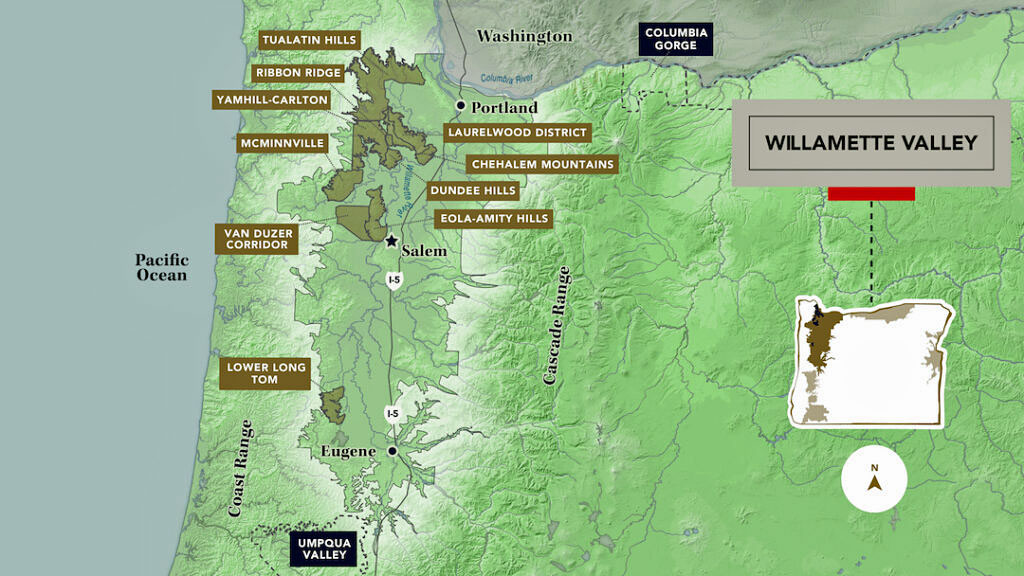
But before I get to our winery visits, it might be useful to provide a brief introduction the Willamette Valley wine region.
Willamette Valley
The Willamette Valley AVA was established in 1984, and covers a very large area in northwestern Oregon. The AVA runs mostly north-south, and is over 100 miles long, extending from the Portland area to the Eugene area. Most of the vineyards are located in the northern portion of the AVA, which has been subdivided over the years into ten smaller and distinct AVAs, all on the west side of the Willamette River. The earliest of these AVAs were approved in the mid-2000s while the most recent ones date from only a few years ago. It’s generally a significantly cooler and wetter area than other Oregon growing regions, which is why varieties such as Pinot Noir, Pinot Gris, and Chardonnay thrive there. Though the daytime temperatures during the annual growing season can get quite warm, it typically cools down significantly at night, and the growing season at this latitude is shorter than areas farther south, such as California.
Much of the vineyard soil of the northern Willamette Valley is either marine sediment or of basaltic volcanic origin, though there are distinctions within these broad types. Some of the Willamette Valley AVAs contain mainly one of these two general types but many of these growing regions – and even some individual vineyards – include both. The differences in wine produced from vines planted in various soil types is one key to understanding the region’s wines. Differences in rainfall in Willamette Valley subregions, locations of gaps in the coastal mountains where cooler marine air is funneled in – such as the Van Duzer Corridor – are additional keys.
I should mention the Deep Roots Coalition, an organization that advocates for non-irrigated farming of wine grapes (dry-farming). The organization’s main goals in promoting dry-farming include the idea that irrigation in vineyards can mask the site’s natural terroir as well as that irrigation is not sustainable in the long term. They also work to promote farming methods that utilize organic methods to control vineyard pests, mildew, and other issues. There are currently over 40 winery and vineyard members of the Deep Roots Coalition, mostly in Oregon plus a couple in California. Several of the wineries I visited on this trip are members.
Although there were a few vineyards planted in Willamette Valley in the 1800s, much of Oregon’s wine production in the nineteenth century centered on vineyards in the warmer Umpqua Valley and Rogue Valley to the south. Willamette Valley’s modern wine history dates to 1965, when David Lett of The Eyrie Vineyards first planted Pinot Noir vines. A few other noted vintners such as Dick Erath planted Pinot Noir later in the 1960s, but it wasn’t really until the 1970s when the area’s Pinot boom began to take off. By the 1980s, Willamette Valley was becoming recognized as a world-class Pinot Noir region. Today there are over 700 wineries in Willamette Valley and over 1,000 vineyards with 33,500 vineyard acres planted. Just over ⅔ of this acreage is planted to Pinot Noir, with Pinot Gris, Chardonnay, and other grape varieties comprising the rest. Willamette Valley is now a highly-regarded wine and food destination for visitors from all over the world.
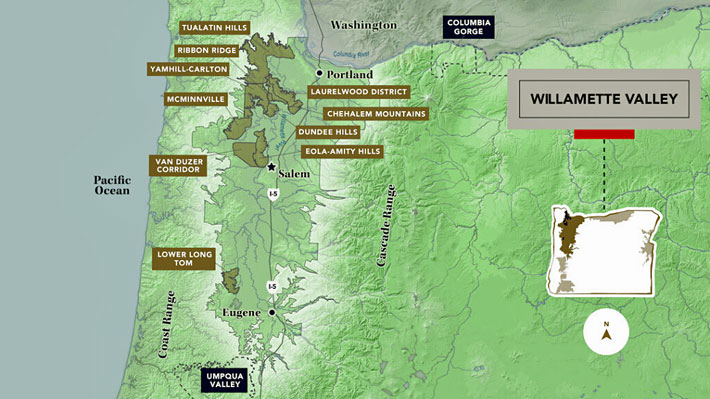 |
| North Willamette Valley (click to expand) |
Map Courtesy of Oregon Wine Board |
Soter Vineyards
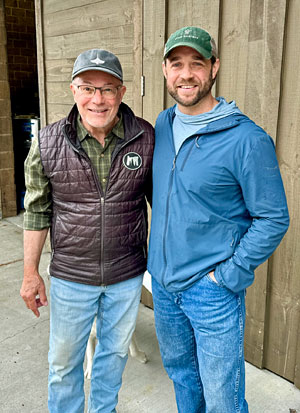 |
| Tony Soter (l) and Chris Fladwood (r) |
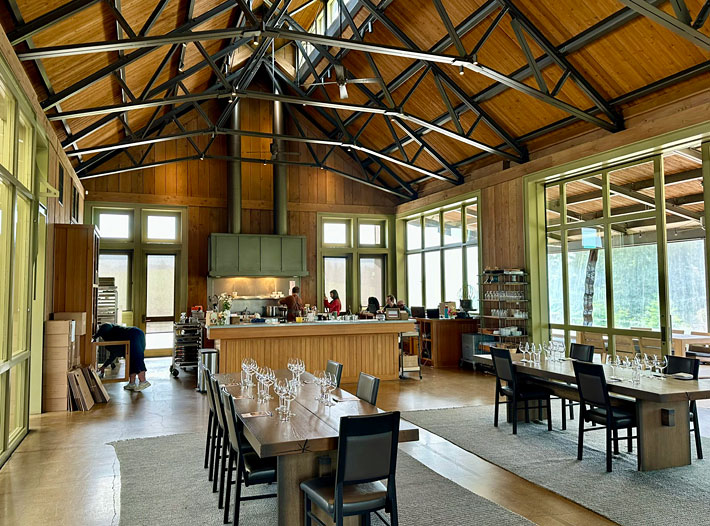
My first visit in Willamette Valley during my Oregon road trip was to Soter Vineyards, just east of the town of Carlton. I spent this day with my friends Steve and Tina, who’d recently moved to Newberg, only a few miles away. Although I’m not sure that I’d tried any Soter wines before, Steve and Tina recommended them and I was able to arrange our visit with Soter’s winemaker, Chris Fladwood. We parked near the tasting room, but it turned out that I’d missed Chris’ email that morning which directed us to head to the nearby winery buildings instead. A text to Chris cleared things up and he said he’d meet us at the tasting room and lead us down to the winery. Steve, Tina, and I sat down in the beautiful, airy tasting room, and since we’d each been handed a glass of rosé when we went in, we were able to enjoy it while we waited for Chris.
Soter Vineyards was established by Tony & Michelle Soter. Tony, who was born in Oregon, has worked as a winemaker for over 40 years. He had a long history in the California wine business before moving to Willamette Valley – he founded Etude Wines in Napa Valley and was a consultant to other noted wineries including Araujo, Chappellet, Shafer, Spottswoode, and Dalla Valle. Michelle, who passed away in 2019, was another Oregon native and not only complemented Tony’s experience with her many years of work in marketing and advertising but also brought environmental awareness to the fore, with a strong belief in sustainability including organic and biodynamic farming. After having difficulty trying to find a vineyard property of their own in California, Tony and Michelle finally found their spot back in their native state of Oregon in 1997 and launched the Soter label with a sparkling wine that year. The couple made the move full-time to Willamette Valley in 2006.
The Soter winery and tasting room are located on the 250-acre Mineral Springs Ranch in the Yamhill-Carlton AVA. The tasting room is at the crest of a rounded hill, and the vineyards are on the slopes all around it, at elevations ranging from 350-500 feet, with sandy marine sediment soil. About 50 acres there are planted with Pinot Noir and Chardonnay vines, with the initial plantings coming in 2002. Mineral Springs Ranch is a Demeter-certified biodynamic farm. Biodynamic practices include integrating a variety of plants and animals (including cattle, chickens, ducks, pigs, and sometimes goats and sheep at Soter) into the ecosystem, nurturing the health of the soil, water, and air, using compost and cover crops in the vineyard, working to maintain pest control with beneficial insects and birds, and never using synthetic-based fertilizers or pesticides.
In addition to Mineral Springs Ranch, the winery has two additional estate vineyard sites, both of which are also biodynamically-farmed. One is located in the nearby Ribbon Ridge AVA – Soter has been making wine from there since 2017 and purchased the property in 2020. At around 500-foot elevation with silty marine sedimentary soil, it’s planted to 18 acres of vines, and the first Ribbon Ridge designated Soter wine is a new 2024 Pinot Noir. The other estate site, Tarren Vineyard, is a little farther south in the Eola-Amity Hills AVA. It’s about 25 acres in size and about 650-foot in elevation, and has rocky basalt-based clay soil with iron oxides. In addition to their three estate vineyards, Soter also purchases some fruit from a vineyard in the Dundee Hills.
 |
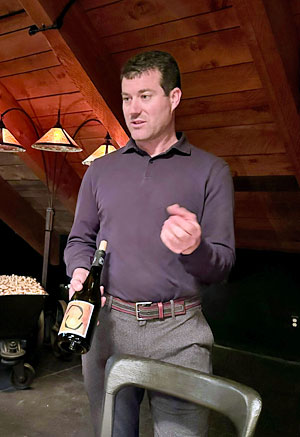
Chris came to the tasting room to meet Steve, Tina, and me, and we followed him to the winery buildings a short distance down the hill. Chris grew up in eastern Oregon, and he told us that his interest in wine started while he was in the Army in the early 2000s and stationed in Baghdad. He got a care package that included a book by Jeff Cox entitled “From Vines to Wines: The Complete Guide to Growing Grapes and Making Your Own Wine” – I have that book too! Chris was initially interested in growing winegrapes, and he realized that to pursue this he needed further education as well as practical experience. He studied horticulture at Washington State University and he was able to work for a winery in eastern Washington during crush. After this he worked for a time in Bordeaux, where his focus shifted more toward making wine than growing grapes. After returning to the Pacific Northwest and working at Shea Wine Cellars in Willamette Valley in 2008 – as well as a stint in New Zealand – he joined the Soter team in 2009, becoming their winemaker in 2013.
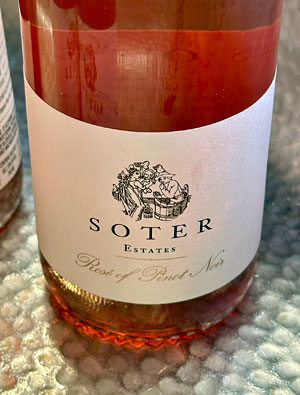
Chris led us into Soter’s wine cave, built around 2003 of poured-in-place concrete with sand later placed to cover it, to taste us on a number of barrel and tank samples. But before I get to that, I should go back to the rosé we’d tried in the tasting room. The fruit for the 2025 Soter Estates Rosé of Pinot Noir was sourced from the Mineral Springs Ranch and Ribbon Ridge vineyards, direct-pressed, and then fermented and aged in both stainless steel tanks and older barrels. The wine had bright strawberry aromas and floral undertones, with light body and a crisp, clean finish.
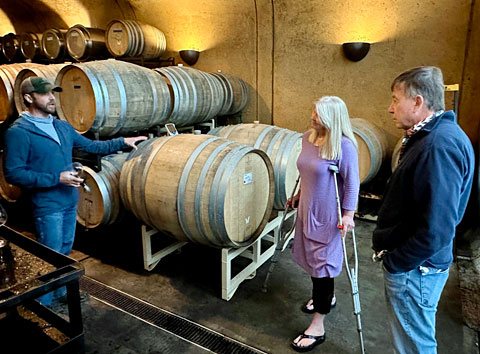 |
| Chris Fladwood, with Tina Jones and Steve Payne |
Chris told us that the winery’s focus is on Chardonnay, Pinot Noir, and sparkling wines, and they produce a little Pinot Blanc and rosé as well. The total annual production is around 15,000 cases per year. He said that his aim is make wines that are “nice when young and extraordinary when older.” He has no set formula or recipe for making the wines, so every one will be different in each vintage with varying percentages of whole-cluster fermentation, co-ferments from different vineyard blocks and clones, etc. Chris described his winemaking as “terroir-supportive rather than terroir-driven.” He’s used a lower percentage of new barrels in recent years (generally around 30%), saying that he feels that too much new oak covers up the artistry of winemaking. As far as cooperage, Chris favors Dargaud & Jaeglé and Taransaud barrels for Chardonnay, and Dargaud & Jaeglé for Pinot Noir.
All of the Soter sparkling wines are made entirely in-house, using the traditional Méthode Champenoise. Most of their sparklers are multi-vintage, and they’re made from slightly different blends of base wine each time, so every sparkling wine is essentially a one-off. Soter sparkling wines spend up to eight years en tirage, and dosage following disgorgement varies from wine to wine and is not pre-determined. Much of the Chardonnay at the Soter vineyards is an older heirloom selection with no official name. Chris uses the technique of allowing early oxidation of the Chardonnay juice prior to fermentation in order to decrease the potential for later unwanted oxidation in the wine and to promote stability. He mentioned that using this technique also results in the wine needing lower sulfur additions.
For Pinot Noir, Chris has generally fermented with 25-35% whole clusters, though he noted that this percentage was a bit lower in the 2025 vintage. He doesn’t foot-tread whole cluster fruit but puts it at the bottom of fermentation tanks with destemmed fruit on top. The fruit undergoes native fermentation, and both punchdowns and pumpovers are done during this time, as well as some pigeage (Chris does all of that). Pinots are typically aged for about 12 months in barrel.
Chris said that the 2025 wines will have final blending done in late 2026 and will be bottled in early spring 2027, to be released in late 2027 and spring 2028. These Soter releases will include sparkling Brut Rosé and Brut Reserve, Mineral Spring Ranch White Label Chardonnay, plus an overall Estates Chardonnay, both Mineral Spring Ranch White Label and Green Label Pinot Noir, Estates and appellation Pinot blends, plus single-vineyard Pinot bottlings from the Tarren, Ribbon Ridge, and Dundee Hills vineyards. Chris explained that the Green Label single-vineyard bottlings for are considered Soter’s flagship wines, while the White Label bottlings are the top-of-the-line wines and are only released in the best vintages. Soter also produces a Blanc de Blancs and Blanc de Noirs in alternate years, and they make the more budget-priced Planet Oregon line of wines as well.
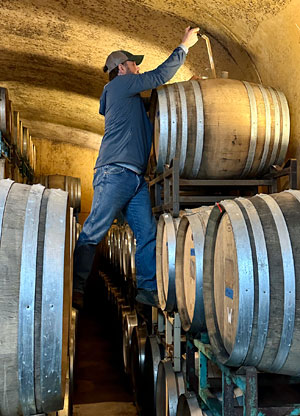 |
Chris began what would prove to be a fascinating and lengthy barrel tasting for Steve, Tina, and me, beginning with Chardonnay barrel samples. We began with a 2025 Tarren Vineyard Chardonnay, tasted from a 2023 puncheon and contrasted it with a 2025 Tarren Vineyard Chardonnay from a 2024 puncheon. The first sample had loads of bright citrus fruit while the second was less fruit-forward with more spice aromas, and both showed great acidity. Chris continued with a 2025 Mineral Springs Ranch Chardonnay, sourced from the vineyard block below winery that was planted in 2012. This displayed very bright and intense citrus plus a distinct saline character and a vibrant texture. A sample of 2025 Mineral Springs Ranch Block 7 Chardonnay was next – made from Soter’s heirloom Chardonnay clone, this block has younger vines planted at a bit higher elevation on a north-facing slope. With a similar profile as the previous sample though a less intense saline quality, this had a bigger mouthfeel with a chalky mineral character. We followed that with 2025 Mineral Springs Ranch Block 16 Chardonnay from the same heirloom clone planted on a different block orientation in 2017 – it had more of a stone fruit aromatic profile with medium weight.
Next, we tasted several lots of base wine that were destined to go into the Soter sparkling wines. The first of these was a 2025 Mineral Springs Ranch Block 16 Chardonnay base wine tasted from barrel, which featured a saline quality similar to the previous wines, though with more zingy acidity and lighter texture. A 2023 Mineral Springs Ranch Chardonnay base wine tasted from a stainless steel drum was next – this will be blended next year to become part of the Sparkling Brut Reserve. A 2021 Mineral Springs Ranch Chardonnay base wine was also from a stainless steel drum – both of these showed lots of citrus and very bright acidity, with more texture on the palate than the 2025 base wine sample. Chris told us that he likes aging a portion of the Chardonnay base wines for sparkling in these stainless steel drums in order to maintain more freshness and purity of fruit while the barrel-aged base wine component adds more richness and complexity to the final blend. One more sample was a 2025 Tarren Vineyard Chardonnay / Pinot Noir base wine. This was about 80% Pinot Noir and 20% Chardonnay that was co-fermented, and will be blended with Mineral Springs Ranch base wine for the Sparkling Brut Reserve. This one showed more stone fruit on the nose and had a pleasant mid-weight mouthfeel.
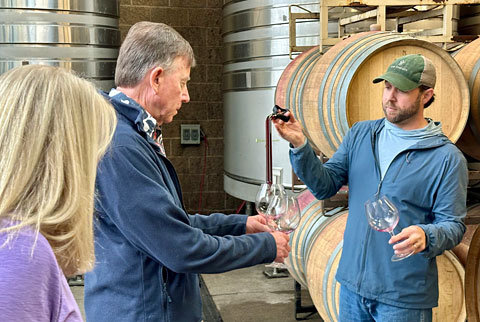
We moved to a different part of the winery space to taste a sample from a stainless steel tank. The NV “9th Edition” Brut Reserve base wine was from the final blend of base wine for this sparkler. It will be bottled soon and then will spend about 5½ years en tirage, with release planned for around 2031. Though I didn’t jot down too much about this one, I did note that it seemed a more complete wine than the earlier base wine samples – not surprising given that it’s the final blend.
 |
Going back to barrel samples, we compared two Pinot Noirs from one vineyard, beginning with a 2025 Tarren Vineyard Pinot Noir. This was about a 50/50 blend of fruit from younger and older vines, using whole-cluster fermented 828 clone and destemmed 667 clone Pinot. The sample had black cherry and earth aromas, and already showed great depth and texture. Next was a 2025 Tarren Vineyard Pinot Noir sourced from older vines with whole-cluster 828 clone and destemmed 115 clone – this had a darker fruit profile with savory herbal undertones and more noticeable tannins.
Continuing the theme with another comparison of Pinot barrel samples from one vineyard, Chris had us taste a 2025 Mineral Springs Ranch Pinot Noir – this was from blocks 11, 12, and 13, planted in 2007, from whole-cluster Pommard clone and destemmed 115 clone. With black cherry, spice, and herbal notes plus a chalky mineral texture, this showed plenty of structure on the palate and finish. We went on to a 2025 Mineral Springs Ranch Pinot Noir sourced from many co-fermented Pinot clones, and then with a 2025 Mineral Springs Ranch Pinot Noir that was blended from six different fermentation tanks. The first of these two had bright red fruit aromas plus herbal and saline notes, with great acidity and texture, while the second had a more noticeable spice character and a broader mouthfeel.
Chris wanted us to try a few more Pinot barrel samples, and we tasted a 2025 Dundee Hills Pinot Noir, the only Pinot we tried from purchased rather than estate fruit. Showing black cherry and spice on the nose, it had a bit more weight on the palate and youthful tannins. We finished our Pinot barrel samples with two more wines from one vineyard. We tasted a 2025 Ribbon Ridge Pinot Noir from a puncheon and then compared that with a 2025 Ribbon Ridge Pinot Noir from a barrique. The puncheon sample featured beautiful floral and red fruit aromas with a lively mouthfeel and slightly chalky tannins, while the barrique sample was more herbal with bigger tannins on the finish.
Chris wrapped up our tasting with a bottle of sparkling wine that was still en tirage with no added dosage yet. The 2022 Brut Rosé was made from about 80% Pinot Noir and 20% Chardonnay. This had bright red fruit and stone fruit aromas, fine bubbles with a creamy texture, and vibrant acidity.
It would have been fun to taste some additional current bottled wines but we were short on time and needed to take off for a quick lunch before heading to our afternoon appointment. Our timing was fortunate when we stepped out of the winery, as we were able to meet Tony Soter, who happened to be on his way in. For those who would like to visit Soter Vineyards, reservations are available for several different tasting options, including their Provisions Experience – a wine tasting paired with a changing food menu that’s mainly from ingredients sourced from Mineral Springs Ranch.
Steve, Tina, and I had a fantastic visit with Chris, and it was quite a treat to be able to taste so many barrel samples with him. We experienced great hospitality at Soter, both at the tasting room and with Chris. He was a wonderful host and did a great job of explaining the distinctions between all of the samples we tasted. Although these wines were still relatively early in their development – and still years away from being finished wines for the sparkling base wines – it was fun to get a snapshot of where they are at this point. It’s always a bit tough to form an opinion on unfinished wines, but my favorites among the barrel and tank samples we tasted included the 2025 Tarren Vineyard Chardonnay from the 2023 puncheon, 2025 Mineral Springs Ranch Chardonnay, 2025 Mineral Springs Ranch Block 7 Chardonnay, 2025 Mineral Springs Ranch Block 16 Chardonnay base wine for sparkling, 2025 Mineral Springs Ranch Pinot Noir from blocks 11, 12, and 13, 2025 Mineral Springs Ranch Pinot Noir co-fermented clones, 2025 Ribbon Ridge Pinot Noir from puncheon, and 2022 Brut Rosé. That’s a lot of favorites, but we tasted a lot of wines with Chris! The bottled 2025 Estates Rosé of Pinot Noir was a very nice way for us to begin our visit as well. Soter is certainly a Willamette Valley winery that would be well worth visiting.
We didn’t have a lot of time for lunch after our visit to Soter, and Steve & Tina suggested stopping in at Red Hills Market in Dundee for sandwiches. There was a fairly long line to order at their counter, as this was Memorial Day Monday so lots of people were enjoying their day off. The line moved along, and when Steve ordered just ahead of me, he was told it would be about a 25-minute wait for the food to be ready – that would make us late to our afternoon wine appointment so I was ready to send the winery a text to let them know. But after we found a seat it was less than ten minutes before our food arrived – not enough time for a really relaxing lunch but enough that we could stay on schedule. I had the wood-fired albacore tuna melt sandwich (served open-face) with provolone, olive oil, lemon zest, and capers, which came with salt & pepper chips and a pickle spear. Red Hills Market was a great choice, as our sandwiches were large and very tasty. After we’d finished, Steve drove us to our next winery visit, not far away at White Rose.
White Rose Estate
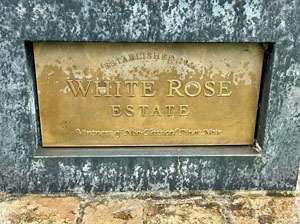
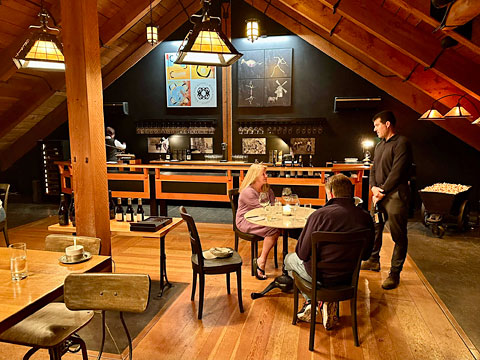
Our afternoon wine appointment was at White Rose Estate, just west of the town of Dundee and in the Dundee Hills AVA of Willamette Valley. I was with my friends Steve and Tina, who’d recently moved to the nearby town of Newberg. A visit to White Rose was on my mind when I first started planning this trip as I’d enjoyed a couple of their Pinot Noirs before, and then Steve and Tina suggested them as well. It was raining lightly but steadily when we arrived at the White Rose parking area, and though it was a little way from there to the tasting room we managed to head inside without getting too wet. We were welcomed in by Greg Urmini, White Rose’s Operations Lead and a key member of their winemaking team. The tasting room is a contrast to many in Willamette Valley – rather than having large windows that open up views to the vineyard and beyond, the White Rose tasting room is windowless and relatively dark, creating a more intimate tasting environment. The idea is to put the focus on the connection between taster and wine by minimizing potential distractions. Completed in 2006, the tasting room is directly above the winery’s barrel room.
White Rose was established in 2000 by Greg Sanders. As with many people in the wine business, he started out in another career – aerospace in his case – before realizing he wanted do go in a different direction. He entered the viticulture and enology program at UC Davis in 1995, and purchased the established 10-acre White Rose vineyard site five years later, with the winery’s first vintage coming in 2001. He continues to work with Greg Urmini as part of the White Rose winemaking team.
Greg Urmini told us that he grew up in Sebastopol, California, and graduated from Cal Poly in San Luis Obispo. It was while he was attending Cal Poly that he first became interested in wine and switched his focus of study to their viticulture and winemaking program. He worked at Linne Calodo Winery in Paso Robles during his college years, and after graduation he was able to work in the Piemonte wine region of Italy. Following that he spent 14 years at Paul Hobbs and Crossbarn wineries in Sebastopol. Greg made the move to Willamette Valley in 2021 and became the Operations Lead of the White Rose winemaking team in 2022.
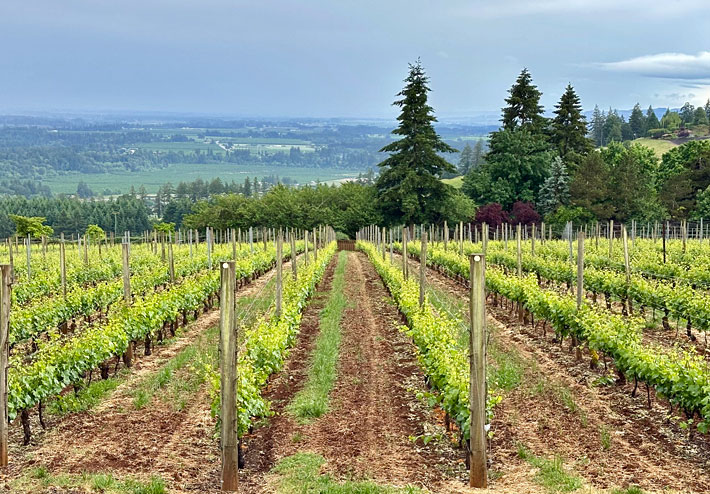
The White Rose Estate vineyard is now about 15 acres in size, planted on the Jory series volcanic soil that’s common to the Dundee Hills region. About 11½ acres are at the hilltop site adjacent to the tasting room and winery, at an elevation of about 750-815 feet. It’s planted mainly to Pommard and 115 clones of Pinot Noir – most of these vines were planted between 1978-1982 and are own-rooted. The rest of the estate vineyard is at a nearby lower elevation site, with Wädenswil, Mount Eden, and Pommard Pinot clones. Nearly all of the vineyard is Pinot Noir, along with some newer Chardonnay that was grafted onto Pinot vines. White Rose uses all of the fruit from their estate vineyard and does not sell any to other vintners.
White Rose’s approach to what they want their wines to express is somewhat different than for many wineries. The focus is not so much on vineyard terroir as on the emotional connection between the consumer and each wine in different settings. The wines are separated into five distinct series that seek to highlight specific feelings and connections. According to the White Rose website, these are “social experiences, learning, collecting, pairing wine with food, and the subjective beauty that can be found in wine.” The idea is to explore what makes the experience of enjoying a wine particularly memorable.
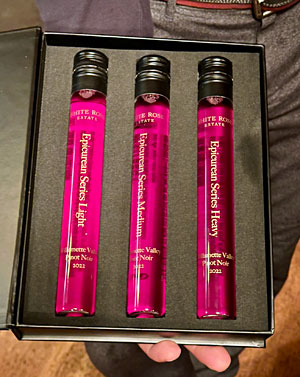
The five series of White Rose wines are Convivialist, Explorers, Epicurean, Collectors, and Aesthete. They each have a different aim, and each is made in a somewhat different way. All of the White Rose wines are Pinot Noir except for a Convivialist series Chardonnay and Syrah. The Convivialist Pinot Noir fruit is harvested from younger vines and uses less whole-cluster fermentation, made to be more approachable early on and to enhance social connections. The Explorers series aims for comparisons in clone, soil, whole-cluster percentage, yeast, vineyard block elevation, and other factors as a way for everyone to keep learning – there’s a different comparison focus in each vintage. The focus of the Epicurean series is to explore the relationship between food and wine. The Collectors series wines are sourced from older vines and higher elevation blocks, and look to highlight the wine’s evolution over time. The goal of the top-of-the-line Aesthete series is to showcase the more subjective qualities in the wines. The underlying objective tying all of these bottlings together is to make ageworthy wines.
Greg told us about the White Rose winemaking as we talked with him. He said that most of their vineyard is harvested at the same time, and that picking decisions are based on chemistry of the fruit, phenolic ripeness, and the state of the vines. Greg finds that fruit grown at the higher-elevation vineyard blocks tends to ripen more slowly and gain a more gentle maturation. The fruit is usually inoculated with selected yeast for fermentation though some lots may be fermented with native yeast. Fruit for the Collectors and Aesthete series of wines is fermented entirely with whole clusters while that for the other series gets a lower percentage of whole-cluster fermentation. For barrel aging, most of the Pinots generally have 10-25% new oak with the Pinots in the Aesthete series being aged in up to 50% new oak. Greg said that most of the barrels are from the Taransaud, Vicard, François Frères, and Sirugue cooperages, and are made with lower toast levels.
The most unique method in the White Rose winemaking process is their use of what they call Segmented Press Fractions – Greg said that to his knowledge no one else does this. This is entirely different than keeping wines separate during the process of a press cycle. In the Segmented Press Fraction technique, wine is extracted three times from whole-cluster fermentation tanks, first from the bottom of the tank and then proceeding with succeeding levels in the tank, determined by taste. The White Rose website explains the aims and results:
• “Step 1: The Initial Extraction – delivering floral perfumes and refined elegance. 10%-11% alcohol
• Step 2: The Secondary Extraction – expressing balance, structure, and varietal purity. 11.5%-12.5% alcohol
• Step 3: The Press Extraction – contributing depth, power, and textural weight. 13.5% – 14.2% alcohol”
After pressing, each fraction is barrel-aged separately, and Greg and the winemaking team make blending decisions later for specific finished wines.
Greg started off our tasting with a lemon verbana tea palate cleanser, a nice way to get tasting room guests prepared for the upcoming wines. Our first wine was the 2023 “Convivialist” Chardonnay – this was made from purchased fruit, and spent 10 months in barrel plus an additional five in stainless steel before bottling. This displayed citrus aromas plus floral and spice undertones, with medium weight and an elegant texture. Next was the 2022 “Convivial Feast” Pinot Noir (from the series that’s now known as “Convivialist”). The fruit for this is partly from the estate vineyard and partly purchased fruit, and the wine was aged in a little over 20% new French oak. With upfront red fruit, this also had spice and floral notes with fine acidity, medium body, and refined tannins.
We continued with a Pinot from the Explorers series, the 2022 “Explorers: Yeast Series” Pinot Noir. This was sourced from the lower-elevation estate site and was fermented with CY3079 yeast, a strain more typically used to ferment white wines. The wine was light and bright, with savory herbal notes along with red fruit and earth on the nose, and with slightly chalky tannins on the finish.
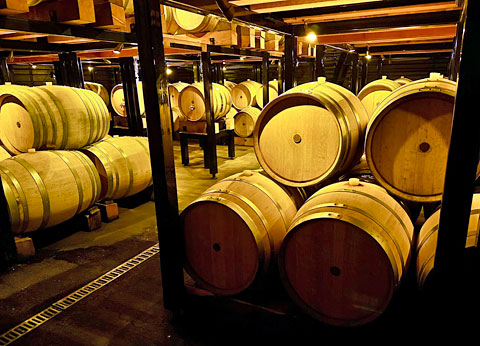
Tina waited in the tasting room while Steve and I followed Greg out the door and into the continuing light rain before we walked down some steps and then into the barrel room directly below the tasting room. The design of the building allows the barrel room to be enclosed by earth on three sides to keep it naturally cool. After a quick look around, Greg tasted us on a barrel sample of a wine that won’t be released for another year or two, the 2024 “Aesthete: Confluence of Nature²” Pinot Noir – this bottling typically is aged in about 33-40% new French oak. The sample we tried was in one of three specially-made “barrels” in the barrel room made specifically for tasting – they’re constructed to look like regular wine barrels but actually have a stainless steel vessel inside. This was a bolder expression of Pinot, with more oak/spice character plus black cherry and earth notes, a broader mouthfeel, and youthful tannins – the further time in barrel this will get before it’s released should help all the components integrate more completely.
We rejoined Tina in the tasting room to continue our tasting, with the 2023 “Collectors: Contemporary” Pinot Noir. Greg explained the distinctions between the “Contemporary” and “Classic” bottlings in the Collectors series. Each of them are barrel selections – the “Contemporary” bottling tends to show darker red fruit with a broader, richer texture while the “Classic” tends to show lighter red fruit with more floral and tea leaf character. This showed a bit riper red and black cherry fruit with floral and spice notes in support, medium weight on the palate, and refined tannins.
|
| Greg (r), with Tina and Steve |
Greg next brought out two of the current Aesthete series Pinots for us to taste, beginning with the 2022 “Aesthete: Object of Beauty” Pinot Noir. Fermented entirely with whole clusters, and generally aged in 10-20% new French oak, this wine came mostly from the earlier press extraction, with 11.5% alcohol. This had lovely floral and red fruit aromas plus notes of earth and spice, with a medium texture and fine tannins on the long finish – delicious now and should continue to develop with more time in the bottle. We compared that wine with the 2022 “Aesthete: Personification of Power” Pinot Noir – also entirely whole-cluster fermented and aged in 50% new French oak, this came from later press extractions and had longer barrel aging, coming in at 14% alcohol. Showing more of a black cherry and plum fruit profile along with a bigger oak/spice component, this had a bolder, more structured mouthfeel and finish – this is deserving of time in the cellar.
Greg concluded our tasting with the 2024 “Convivialist” Syrah. The fruit for this was sourced from Borderlands Vineyard in Oregon’s Rocks District AVA. The finished wine is a blend from one tank that was fermented entirely with whole clusters and another that was entirely destemmed and co-fermented with Viognier – the final blend is about 60% whole cluster and 6% Viognier. This was aged for 10 months in barrel with about 15-20% new French oak. This was a lighter and brighter rendition of Syrah, with herbal and floral aromas to go with dark berry fruit and spice and a touch of pepper, with medium body and good structure. It gave me the impression of a Syrah made by a Pinot specialist – not a bad thing in my book.
In addition to all of the wines from the five series mentioned above, White Rose has produced a recently-released “25th Anniversary” Pinot Noir – it’s a blend from the 2023 and 2024 vintages. Greg told us that the winery makes about 3,000 cases per year, most of which is sold direct to consumer. He also noted that the wines have new label designs starting with the 2023 vintage. The White Rose tasting room is open daily, and they offer several tasting options – reservations are suggested.
Steve, Tina, and I all enjoyed our visit to White Rose. Greg was a very engaging host for us, and did a fine job of talking with us about the wines we tasted, the goals behind them, and some of the unique winemaking methods used at White Rose. The tasting experience was different than at the other visits during my Oregon wine trip – it was both more focused and more intimate. Of the wines we tasted with Greg, I particularly enjoyed the 2023 “Convivialist” Chardonnay, 2023 “Collectors: Contemporary” Pinot Noir, 2022 “Aesthete: Object of Beauty” Pinot Noir (my overall favorite), and 2024 “Convivialist” Syrah. The price points of the White Rose wines vary with the different series they’re in. A tasting at White Rose will be a memorable experience for visitors to the Willamette Valley wine region.
After we got back to Steve and Tina’s house following our tasting at White Rose, Steve grilled some ribeye steaks and we enjoyed a delicious dinner. My Saturday visit to Teutonic in Portland with Jon, Ling, and Wes, and my Monday Willamette Valley visits with Steve and Tina to Soter and White Rose were all fun, with lots of good wines. Since I was spending two more days visiting with Steve and Tina at their house in Newberg, I’d arranged four more winery visits, two each on Tuesday and Wednesday.
|