Oregon Wine Visits, May 2026 – Part 4
This Wednesday would be my last day staying with friends Steve and Tina at their house in Newberg in Willamette Valley. We’d visited two wineries each on Monday (Soter and White Rose) and Tuesday (J.K. Carriere and Day Wines) in addition to my wine visit with other friends on Saturday in Portland (Teutonic). As was the case the previous day, Steve was unable to join us due to work commitments on Wednesday, but this time our friend Wes would meet up with Tina and me for our winery visits. Fortunately, I had just enough time before Tina and I needed to leave for our first appointment to do some laundry at their house, mainly to wash the smoke out of the clothing I’d worn the previous evening as we sat around Steve and Tina’s backyard fire pit! We got on the road on time and drove to McMinnville for our morning visit to Goodfellow Family Cellars.
Goodfellow Family Cellars
The first wine visit on my final day in Willamette Valley was at Goodfellow Family Cellars in McMinnville. Once again I drove my friend Tina from Newberg and we planned to meet our friend Wes at the winery. I’d had a few Goodfellow Pinot Noirs over the years and always enjoyed them, and when I visited Willamette Valley in 2023 I’d hoped to visit but wasn’t able to make it work out, so I was very happy to arrange the visit there on this trip. Tina and I briefly had a little difficulty finding the winery – it’s in a group of industrial buildings off of a street – until Tina saw the Goodfellow sign on one of the buildings and almost simultaneously I spotted Wes’ car outside of it. We walked into a side doorway that was open and found Wes talking with vintner Marcus Goodfellow inside. Marcus welcomed in Tina and me, and he began telling us a little about his background.
Marcus is a native of Oregon and his family has been there for several generations. One of his grandfathers came to Oregon to work on the Bonneville Dam on the Columbia River in the 1930s, and his other grandfather moved to an 80-acre property near the town of Silverton – that spot, a Douglas Fir tree farm, is where Marcus grew up. Marcus told us that his early work as a restaurant bartender, first in Los Angeles and then in Portland, developed his interest in looking at and experimenting with specific aspects of drinks such as acidity and texture, and that this helped him better understand wine. His work in the restaurant business gained him an appreciation for wine and he realized he needed to learn more about it. Marcus became a firm believer in the potential for Oregon wine.
Marcus has noted that he was inspired by the vintners at Cristom, Elk Cove, and other wineries, and that this made him believe that Burgundian wine quality was achievable in Willamette Valley. As with many vintners he mainly learned on the job, working a harvest at Evesham Wood before launching his own wine business in 2002 while helping during harvest at Westrey Wine Company in McMinnville. Marcus has said that the early wines were made on a shoestring budget, trading labor at Westrey for the opportunity and space to make wine there. His first wine in that 2002 vintage was a little under 200 cases of Pinot Noir, made with partners under the Matello wine label. After their early vintages made at Westrey they later moved to a couple of other locations. By 2010 Marcus was making wines under the Goodfellow Family Cellars label as well as Matello and gradually changed over everything to Goodfellow by about 2016. The winery has been in its current McMinnville facility since 2018. Marcus now partners in the Goodfellow winery business with his wife Megan Joy, and she’s also the associate winemaker there. Marcus and Megan do nearly all of the work at the winery themselves.
|
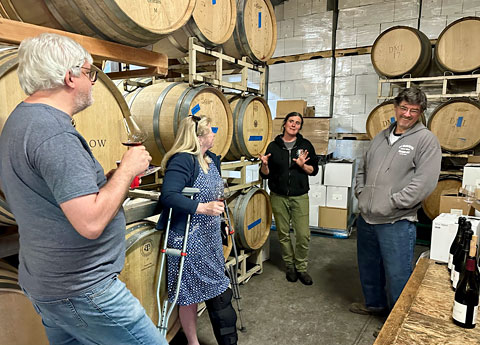
| From left: Wes Barton, Tina Jones, Megan Joy, and Marcus Goodfellow |
The focus of the Goodfellow wines is on Chardonnay, Pinot Noir, and sparkling wines. We talked a little with Marcus about his vineyard sources. Goodfellow purchases fruit from a number of sustainable and organically-farmed Willamette Valley vineyards, all of which are dry-farmed, and most are no-till. Like several of the other wineries I visited on my recent trip, Goodfellow is a member of the Deep Roots Coalition, which advocates for dry-farming and limited intervention in the vineyard – Marcus is currently a member of their Board. He’s also a firm believer that fruit from older vines tends to be higher quality and will make better wine, so this is one key to his selection of vineyard sources. He doesn’t work with fruit from young vines at all, and favors those that are over 20 years old. Similar to what we heard from a couple of other vintners on this trip, Marcus feels that Pinot clones are not that important as vines mature, and he prefers vineyard blocks with multi-clonal Pinot Noir plantings. He noted that there can be as much as a 30-40 degree diurnal shift during the growing season at his vineyard sites.
Marcus gets much of his fruit from three highly-regarded vineyards – Whistling Ridge, Durant, and Temperance Hill. The soil at Whistling Ridge Vineyard in the Ribbon Ridge AVA is entirely marine sediment and the first vines were planted there in 1990. Durant Vineyard in the Dundee Hills AVA, initially planted in 1973, has four- to six-foot deep volcanic soil, and Temperance Hill Vineyard in the Eola-Amity Hills AVA has shallower volcanic soil and plantings that date to 1981. Marcus gets both Chardonnay and Pinot Noir from these three sites, and also gets some Pinot Gris and Riesling (and sometimes a tiny amount of Cabernet Franc) from Whistling Ridge. Other key vineyards for Goodfellow include Tsai Vineyard and Fir Crest Vineyard, both in the Yamhill-Carlton AVA. Marcus told us that he wants the wines to highlight the vineyards and growers.
Fruit for the Goodfellow wines is generally picked a bit earlier than it is for many vintners in order to preserve acidity in the fruit and the resulting wines. Pinot Noir is fermented with whole clusters, and Marcus was inspired in this practice by the wines of Domaine Dujac, by Cristom’s Steve Doerner, as well as by others. Since there’s no limestone soil in Willamette Valley as there is in Burgundy, he feels that the stems help provide needed structure to the wines that limestone soil would otherwise contribute. He told us that he used to do a range of percentage for whole-cluster fermentation in his Pinots, and that it’s mostly 100% whole-cluster now. Fermentation with native yeast takes place in bins, and the fruit gets foot-treading and then pumpovers until fermentation starts, when it then begins to get punchdowns. The wine is generally on the skins for 35-45 days prior to pressing, and Marcus favors older and larger oak vessels – 500-liter, 600-liter, and 800-liter – for aging the wine as well as some new barriques. He mentioned that the wine tends to be more restrained when aged in the larger vessels though this can vary for different vineyards and vintages. The Pinots are typically barrel-aged for about 17-19 months. Because these wines are entirely from whole-cluster fermentation, Marcus feels that they deserve time in bottle to show their best, and he suggested holding them until about nine years from the vintage.
For white wines, Chardonnay is fermented and aged in a combination of neutral and new French oak barriques as well as larger oak vessels. The single-vineyard Chardonnays are aged in barrel on the lees for around 19-21 months. For the Pinot Gris, Marcus favors acacia barrels as he feels they help give it a floral lift. He doesn’t use any amphorae or concrete tanks for fermentation or aging of any of his wines. Chardonnay base wine for the Goodfellow sparklers is often made in larger oak vessels. Made entirely in-house, sparkling wines typically spend about three years en tirage and the get only a very small dosage or none at all. Marcus mentioned that the 2023 Goodfellow wines tend to be lower alcohol than some vintages but have similar flavor profiles to other vintages of the same wines. He also noted that the 2025 wines will also have lower alcohol.
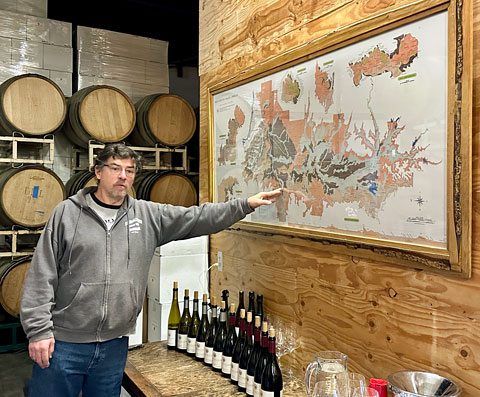
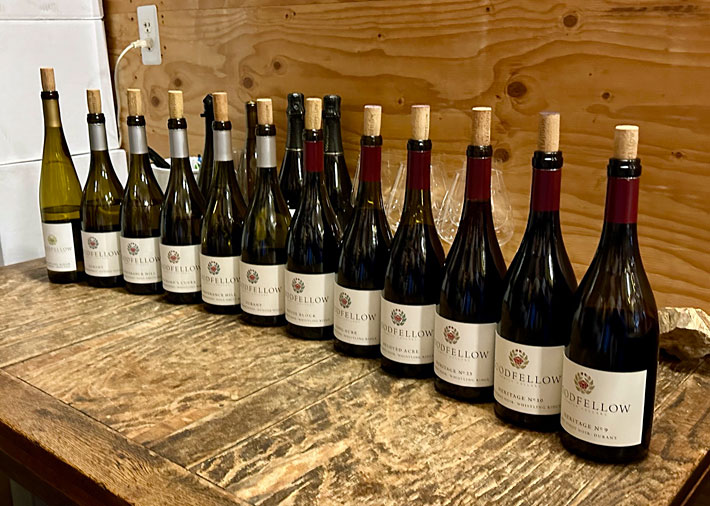
We began our tasting with Marcus in a corner of the Goodfellow barrel room. After awhile Megan joined us as well, and when Marcus had to attend to other business Megan took over our tasting – both were delightful hosts! We started with the 2024 Whistling Ridge Vineyard Riesling, which Marcus said came from a particularly windy area near the top of the ridge. This had very bright citrus aromas, a floral touch, and just a hint of Riesling petrol, with medium-light body and zippy acidity on the tasty finish.
We continued with three current release Chardonnays, beginning with the 2023 Durant Vineyard Chardonnay – this fruit came from a cooler spot near the foot of the vineyard slope, and the wine was aged in a 500-liter puncheon. This had beautiful aromas of citrus and stone fruit, flowers, and a minerally saline note, with medium-light mouthfeel and a vibrant finish. The 2023 Temperance Hill Vineyard Chardonnay came from a vineyard block that gets plenty of cool marine air funneling in from the coast through the Van Duzer Corridor – this wine was aged in both new and neutral oak. Displaying more of a pear and spice profile along with fresh herbs and earth, this had a bit more weight on the palate with fine acidity. The 2023 Whistling Ridge Vineyard “Richard’s Cuvée” Chardonnay was sourced from vineyard blocks of mixed Dijon clones and California heritage selections, and was aged in neutral barriques and foudre. A bit reductive at first, but with a few moments of air it revealed pear, citrus, saline minerality, and earthy undertones, with a somewhat fuller texture yet still with plenty of fresh acidity.
Marcus followed those wines with two older Chardonnays. The 2021 Temperance Hill Vineyard Chardonnay was fermented and aged in a new 800-liter foudre and a neutral 600-liter barrique. As with the previous wine, this needed some air to open up, and it was worth the short wait – bright citrus and stone fruit, fresh herbs, and a stony mineral quality with great texture and balance, and a long and lively finish. We also tasted the 2019 Durant Vineyard Chardonnay, which came from vines planted in 1993. It featured green apple and lime on the nose with touches of savory herbs and yeast lees, medium-bodied and still showing bright acidity on the palate and the finish.
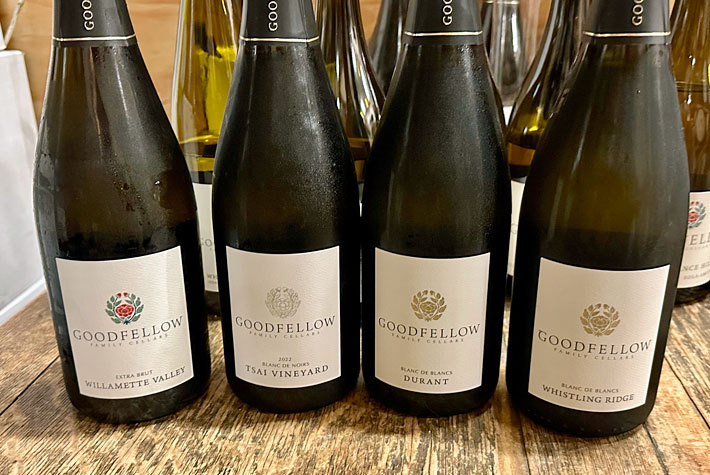
Megan brought in four sparkling wines, which we tasted next. The NV Willamette Valley Extra Brut was made from 68% Chardonnay from the 2019 and 2020 vintages and 32% Pinot Noir from the 2022 vintage. With apple and citrus, yeast, and stony mineral undertones, this was a bit lighter weight but still displayed a very pleasant texture and finish. The base wine for the 2022 Tsai Vineyard Blanc de Noirs was originally destined to be a component of the Willamette Valley Extra Brut, but it proved to be distinctive enough for a standalone sparkling bottling. This had more purity of bright red fruit plus a touch of grapefruit with less of a yeasty note, fine bubbles, and a vibrant finish. We next tasted the NV Durant Vineyard Blanc de Blancs – this was made mostly with base wine from the 2020 vintage plus some from 2019 and 2021. Showing apple and pear fruit plus touches of earth and yeast, it had a bigger mouthfeel and long tasty finish. Our last sparkling wine was the NV Whistling Ridge Vineyard Blanc de Blancs, with about 60% from the 2019 vintage and 40% from 2022. This displayed green apple and citrus aromas and a more noticeable yeasty element, with great texture plus zingy acidity, very fine bubbles, and a fresh lingering finish.
We moved along to Pinots next, and the first of these was the 2023 Whistling Ridge Vineyard “House Block” Pinot Noir. The fruit for this bottling came from the first block planted at the vineyard 1990, on a west-facing slope. This featured pretty floral aromatics plus red fruit, forest floor, and spice notes, with medium-light body and fine tannins. We followed that with the 2023 Whistling Ridge Vineyard “Long Acre” Pinot Noir – from a mixed clonal planting, these southeast-facing vines were planted in 1991. Showing bigger earth and forest floor / mushroom components along with red fruit and floral undertones, this had a somewhat bigger mouthfeel and tannic structure. One more single-block wine from the vineyard was the 2023 Whistling Ridge Vineyard “Beloved Acre” Pinot Noir. This was planted in 1996 with a mix of clones, and the block runs near the ridgeline so it has more wind exposure. Black cherry aromas were upfront with earth and tea leaf in support, with medium weight on the palate, great acidity, and a long, lively finish. Though we didn’t taste a Pinot Noir from the Whistling Ridge Experimental Block, located next to Long Acre, Marcus said that the Pinot at that block is 100% Wädenswil clone planted on seven different rootstocks.
About this time Marcus needed to leave our tasting and Megan led us through three more wines, all from Goodfellow’s Heritage series of Pinot Noirs, their top-of-the-line bottlings. They’re bottled from selected barrels and puncheons in the cellar and meant to be the winery’s most ageworthy Pinots. The 2023 Whistling Ridge Vineyard “Heritage No. 23” Pinot Noir came from this vineyard’s Beloved Acre block. Displaying red and black cherry fruit, spice, flowers, and forest floor aromas, this was medium-bodied with fine structure and a vibrant texture and finish. Megan next poured us two older Heritage series wines to finish up our tasting. The 2017 Whistling Ridge Vineyard “Heritage No. 10” Pinot Noir was also sourced from the Beloved Acre block, and featured black cherry, forest floor / mushroom, and background floral notes, with medium weight and still showing plenty of structure for continued cellaring. We finished up with the 2017 Durant Vineyard “Heritage No. 9” Pinot Noir – this had a bit more upfront red fruit and spice plus floral and savory herbal notes in support, with great texture and structure and fine tannins on the long finish.
In addition to the wines we tasted with Marcus and Megan, Goodfellow makes additional Chardonnay and Pinot Noir bottlings, as well as Pinot Blanc from Tsai Vineyard and Pinot Gris and a white field blend, both from Whistling Ridge Vineyard. They also make a tiny amount of Cabernet Franc from Whistling Ridge but there are so few of the Cab Franc vines that there’s not enough of the wine to bottle as a single vintage – the most recent one is made up of wine from four vintages. Total annual production for the Goodfellow wines is around 4,000 cases. Goodfellow does not have a formal tasting room, and visits to the winery are available by appointment.
Both Marcus and Megan were terrific hosts to Tina, Wes, and me. We didn’t get to spend that much time with Megan – hopefully we’ll be able to do that next time we visit – though it was so much fun talking with Marcus. He’s got a sly sense of humor, while it’s clear that he and Megan are totally dedicated to producing very high quality wines. Among the producers we visited in Willamette Valley, the Goodfellow wines may have been the most distinctive – every one of them displayed laser-focused acidity. I really enjoyed all of them, though if I have to choose favorites, they’d be the 2024 Whistling Ridge Vineyard Riesling, 2023 Durant Vineyard Chardonnay, 2023 Whistling Ridge Vineyard “Richard’s Cuvée” Chardonnay, 2021 Temperance Hill Vineyard Chardonnay, 2019 Durant Vineyard Chardonnay, NV Durant Vineyard Blanc de Blancs, NV Whistling Ridge Vineyard Blanc de Blancs, 2023 Whistling Ridge Vineyard “House Block” Pinot Noir, 2023 Whistling Ridge Vineyard “Beloved Acre” Pinot Noir, 2017 Whistling Ridge Vineyard “Heritage No. 10” Pinot Noir, and 2017 Durant Vineyard “Heritage No. 9” Pinot Noir. That’s a lot of favorites! But it shows how good I felt the Goodfellow wines were, and on top of that, the wine prices are very reasonable given the high quality. Arranging a visit to Goodfellow is really a must if you’re in Willamette Valley wine country.
I’d scheduled our Wednesday afternoon wine visit for a bit later than the ones we’d had the previous two days, so Tina, Wes, and I had more time to relax and enjoy our lunch on this day. As we were getting ready to leave Goodfellow that morning we asked Megan for suggestions of nearby lunch spots, and she recommended stopping in at nearby Mac Market in McMinnville. It’s an upscale food court in a large airy space, with a pleasant central indoor seating area and food available from a few places on several sides of the seating. As soon as we walked in, we all smelled the food from Honey Pie Pizza, and immediately decided that’s where we would go. They had a number of tempting options on their menu, and we split their Fungus Amongus pie, with mushrooms, mozzarella, ricotta, honey, carmelized onions, oregano, garlic, and truffle oil. It tasted as good as it smelled, and we were very happy with our choice. Even with about a half-hour drive ahead of us to our afternoon winery appointment we still had time to have a very relaxing lunch. Eventually we headed out to our last wine visit of the day at Kelley Fox Wines.
Kelley Fox Wines
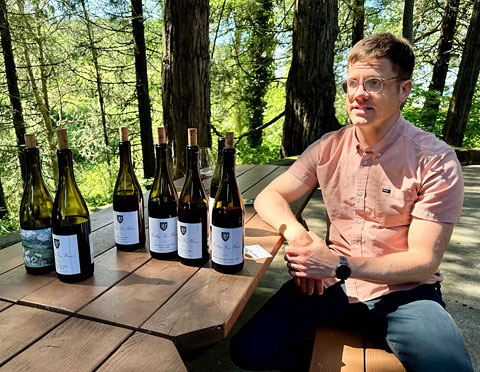
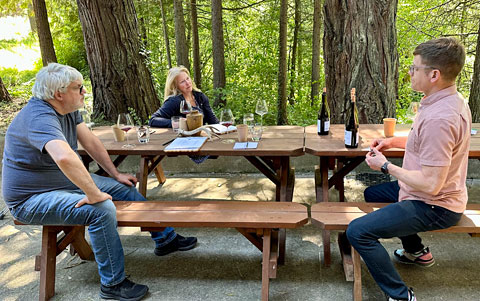
The final Willamette Valley wine visit of my trip was at Kelley Fox Wines. My friends Tina and Wes joined me once again, and we pulled into the parking area of ADEA Wine Company in the Yamhill-Carlton region, where Kelley makes her wine. I’d had a couple of Kelley Fox Pinot Noirs in the past and liked them quite a bit, so I was glad that I was able to arrange an appointment to taste there. As we walked toward the winery building we were greeted by Kelley’s tasting host, Director of Consumer Sales Jonathan Ziemba. He led us to the back of the winery, where he’d set up the tasting for us at a wooden table below beautiful tall cedar trees. Though Kelley was tied up in a meeting that afternoon and was unable to join us, Jonathan was a fine host for our group.
Kelley studied psychology and biology at Texas A&M University, and followed her degree there with graduate degrees in biochemistry and biophysics from Oregon State University. It was while she was in their PhD program in that she decided to change course to making wine. Kelley has lived in Willamette Valley since the late 1980s, and learned winemaking from a number of famed Oregon vintners – she particularly credits the late David Lett of The Eyrie Vineyards for influencing her path to becoming a winemaker. She’s worked as a winemaker since 2000, working at Eyrie, Torii Mor, Hamacher, and other wineries, and spending ten years as the winemaker at Scott Paul Wines. Kelley established her own label in 2007 with her father Gerson “Gus” Stearns. Since 2015 she’s focused exclusively on her own label, and she’s been making her wines at the ADEA facility since 2018.
Kelley looks to reflect the terroir of the vineyards she works with in her wines. She prefers working with fruit from older vines, and she’s been able to work with a number of highly-regarded vineyard sites. The winery is a member of the Deep Roots Coalition, which promotes dry-farming. Fruit is picked on the early side, with a goal of maintaining its fresh character. All of Kelley’s Pinot Noir fermentations take place in bins using native yeast and with daily pigeage. She uses varying percentages of whole-cluster fermentation for these, depending on the vintage and vineyard. Jonathan told us that the 2023 Pinots were mostly destemmed, while the 2024s typically were fermented with about 30% whole clusters. All of the Pinots are aged entirely in neutral French oak, generally spending 9-10 months in barrel. Chardonnays are barrel-fermented and aged in a mix of some new and mostly older French oak.
As we sat down with Jonathan, he told us a little about his background. He first became interested in wine while working in fine dining restaurants in Chicago. He moved to Newberg in Willamette Valley in 2015 and has mainly worked at wineries since then. He now lives in Portland, and he’s worked at Kelley Fox for about 3½ years.
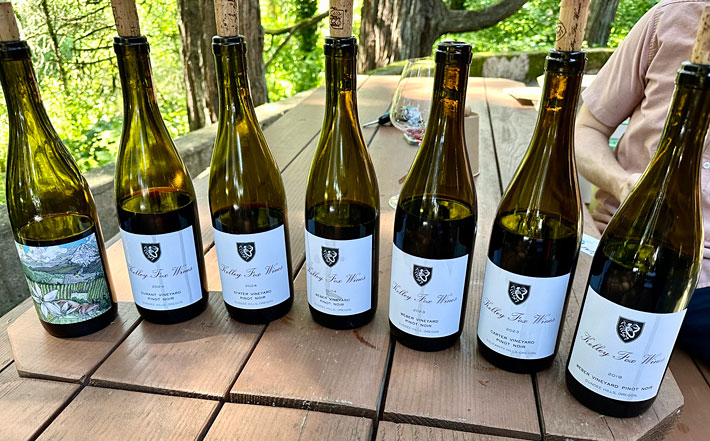
Jonathan noted that the 2024 single-vineyard Pinots that Tina, Wes, and I tasted with him were all pre-release, and will be released later this year. The 2024 single-vineyard Chardonays have been recently released. Jonathan told us that three of their main Pinot vineyard sites – Weber, Durant, and Stater – are in the Dundee Hills AVA of Willamette Valley. Carter Vineyard is located in the Eola-Amity Hills AVA farther south, and Freedom Hill Vineyard is near the same region. Stater Vineyard has become the main source of Pinot Noir fruit for Kelley Fox, and they also get Pinot Blanc from there. All of the Pinot vineyard sites are on volcanic soil with the exception of Freedom Hill, which is on marine sediment soil. Jonathan said that all of the Kelley Fox Pinot Noir fruit comes from Pommard and Wädenswil Pinot clones.
Our first wine was the 2024 “Mirabai” Pinot Noir – this bottling is sourced from several vineyards, typically from two or three of the Dundee Hills sites. Kelley has made this bottling since 2008 and it’s the winery’s largest production bottling, generally with about 800 cases. The wine displayed bright cherry fruit, spice, and forest floor aromas, with medium body, a lively mouthfeel and fine tannins – this should be a very food-friendly Pinot.
Jonathan poured us three pre-release Pinots, starting with the 2024 Durant Vineyard Pinot Noir. The fruit was sourced from 1973 and 1984 plantings at the site. This had somewhat deeper red and black cherry fruit plus delicate floral notes and a touch of spice, with a bit more weight than the “Mirabai” Pinot. Next was the 2024 Stater Vineyard Pinot Noir, which came from vines planted in the early 2000s. With black cherry, spice, and a savory herbal note, this had a bigger mouthfeel and more structured finish. We followed that with the 2024 Weber Vineyard Pinot Noir – the first Pinot vines were planted there in 1978, and the fruit for this wine came from 1983 plantings. My favorite of the three 2024 single vineyard bottlings, this featured bright and very savory red fruit with undertones of flowers and spice, medium body with lively acidity, and fine tannins.
We continued with current release single-vineyard Pinots, beginning with the 2023 Weber Vineyard Pinot Noir. It had more of a black cherry profile than the 2024 bottling, with a broader mouthfeel along with good structure. We tasted one more current release, the 2023 Carter Vineyard Pinot Noir – from vines planted in 1983, this vineyard site has marine influence from the Van Duzer Corridor that allows cool air to flow inland from the coast. This displayed earthy black cherry fruit, dried herbs, and a touch of spice, with a bigger texture and tannic structure – this should benefit from some time in the cellar. Jonathan opened a library wine for us, the 2019 Weber Vineyard Pinot Noir. He told us that this was just the second vintage for Kelley from this site and that the 2019 vintage was a cooler and wetter one in Willamette Valley. Showing savory herbal and forest floor aromas along with red fruit and spice, this was medium-bodied with a lively mouthfeel and refined tannins.
Moving along to white wine, we tasted the 2025 Willamette Valley Grüner Veltliner, which was sourced from three vineyards and made entirely in stainless steel. It had bright citrus and stone fruit aromas, with touches of spice and pepper, medium-light weight and a long tasty finish. We next tried the 2025 Willamette Valley Pinot Blanc – the fruit came from Freedom Hill and Stater vineyards, and the wine was made in a mix of older French oak, a neutral acacia puncheon, and concrete tanks. With pear and subtle floral notes, it combined lively acidity with a broader texture and finish.
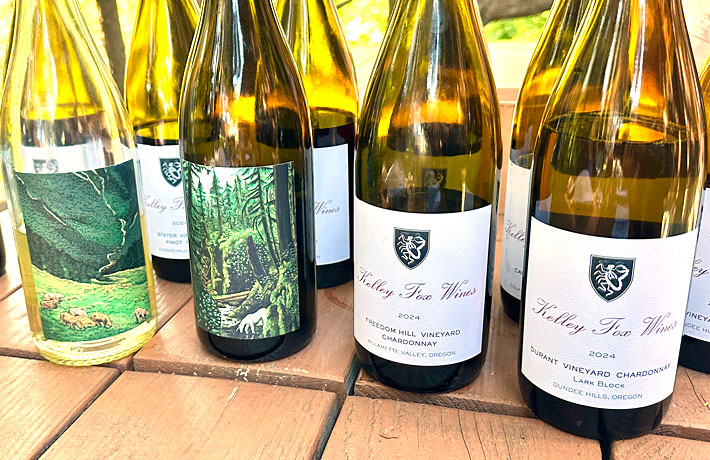
We finished our tasting at Kelley Fox with two recently-released Chardonnays, both very small production. First was the 2024 Freedom Hill Vineyard Chardonnay – sourced from younger vines, it’s Kelley’s first single-vineyard Chardonnay from this site. The wine was fermented and aged in about 30% new French oak and was given some bâtonnage in barrel to increase the texture. Showing pear, earth, and spice notes, this had a round mouthfeel with a chalky mineral quality on the finish. Our final wine was the 2024 Durant Vineyard Lark Block Chardonnay. Unlike the rest of Durant Vineyard, the Lark Block has marine sediment soil, unusual in the Dundee Hills. The wine was made in a similar way to the Freedom Hill bottling. This featured bright citrus and apple aromas plus touches of stone fruit, spice, and flowers, with fine acidity and a lively texture and finish.
Most of the Kelley Fox wine production is Pinot Noir, with a number of bottlings. In addition to the wines we tasted on this visit, they also make additional Pinot Blanc and Chardonnay bottlings as well as a small amount of Albariño, a Black Raspberry wine, and a blend called “Nerthus.” Total annual production ranges from 3,000-5,000 cases per year. Jonathan mentioned that Kelley’s daughter, artist Violet Fox, did the colorful label artwork that appears on some of the wines. Kelley Fox does not have a formal tasting room, and tastings are available by appointment only.
Tina, Wes, and I had a great time tasting the Kelley Fox wines in such a serene setting under the trees with Jonathan. He was an engaging and knowledgeable host. We enjoyed all of the wines, and I always appreciate it when wines show such distinctiveness between vineyards as the Kelley Fox wines did. That’s a good sign that the winemaker is using a lighter hand and letting the vineyard terroir show through in the wines. I liked all of the wines we tasted with Jonathan, particularly the 2024 “Mirabai” Pinot Noir, 2024 Durant Vineyard Pinot Noir, 2024 Weber Vineyard Pinot Noir, 2023 Carter Vineyard Pinot Noir, 2025 Willamette Valley Grüner Veltliner, and 2024 Durant Vineyard Lark Block Chardonnay. Kelley Fox is certainly producing excellent wines, and prices are in line for the quality. Arranging a visit to taste there is definitely recommended if you’re in Willamette Valley.
Wes headed his separate way from Tina and me after our visit to Kelley Fox on Wednesday afternoon. We’d all had a great time visiting there as well as Goodfellow that morning. It was a bit longer drive back to Steve and Tina’s house in Newberg that afternoon, and after we got back we got ready for dinner. Steve and Tina had suggested a local café they’d enjoyed, with the clever name of Newbergundian. It’s a small place, and since the weather was considerably warmer on Wednesday than it had been the previous couple of days, we sat outside on their patio. We shared a terrific wedge salad with iceberg lettuce, tomato, bacon lardons, crispy shallots, blue cheese, and chives, and my entrée was penne pasta with wild netto pesto, olive, garlic cream, Pecorino Romano, frico, and arugula, which was also delicious. We ordered a bottle from the Newbergundian wine list to share as well, the Domaine Divio 2023 Willamette Valley “Passetoutgrain” – made from ⅔ Gamay and ⅓ Pinot Noir, it went well with all of our meals.
This was my final night staying at Steve and Tina’s house, and I would be starting my drive back to Oakland the following morning via the Oregon and California coast. I wanted to get an early start the next day so I packed most of my stuff into my car on Wednesday evening, and after a light breakfast with Steve and Tina on Thursday morning I said goodbye to them and headed out to the coast. It was a very enjoyable and relaxing trip down the coast, with time to revisit a few places and to check out some that were new to me.
But wait, there’s more!
Postscript – The Eyrie Vineyards
A couple of weeks after I got back from my Oregon road trip I was able to attend a tasting of wines from The Eyrie Vineyards at the Wine on Piedmont wine shop in Oakland. Eyrie is one of the oldest and most famed wineries in Willamette Valley. I’d hoped to visit there while I was in the area a couple of weeks earlier but the timing didn’t work out, so I was glad that this tasting came up so shortly after I returned home.
In 1965 Eyrie founder David Lett and his wife Diana planted the Willamette Valley’s very first Pinot Noir, Chardonnay, and Pinot Gris vines in the Jory volcanic soil at their property in the Dundee Hills. This planting is widely recognized as the foundation of the modern wine era in Willamette Valley. Eyrie’s first vintage came in 1970, and David and Diana’s son Jason took over the winemaking in 2005. David passed away in 2008, and Jason continues to run the winery with the active participation of Diana.
Over the years, Eyrie has expanded their estate vineyards, and all of their wines are now sourced from five hillside sites in the Dundee Hills, all of which are dry-farmed, no-till, and certified organic. As with several of the wineries I visited in Oregon, Eyrie is a member of the Deep Roots Coalition that promotes dry-farming. Both viticulture and winemaking at Eyrie have been described as using a “gentle touch.” Fruit is fermented in fairly small lots with native yeast. Pinot fruit is almost entirely destemmed, with only a small percentage fermented with whole clusters. Most white wines are in barrel on the lees for up to 18 months and Pinots are aged for up to two years, in mostly older French oak barrels.
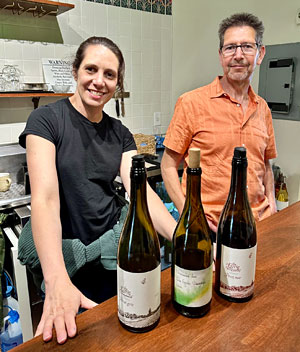
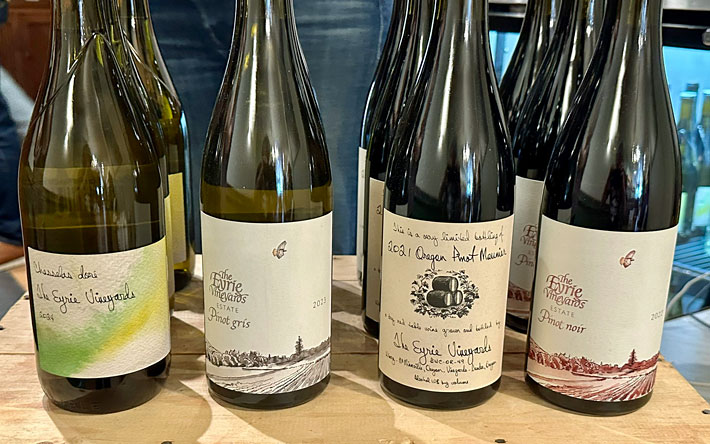
Fabrice Habelski of Eyrie’s Northern California distributor Northwest Wines was on hand at Wine on Piedmont along with shop owner Adriana Fabbro to pour four current releases, and a few of us were able to taste a fifth wine as well. We began with the 2024 Estate Chasselas Doré – this was made entirely in stainless steel with 11 months of aging on the lees. The wine had bright stone fruit and floral aromas with a touch of lemonpeel, and a lively mouthfeel and finish. We continued with the 2023 Estate Pinot Gris, from nearly 30-year old vines. Made in a similar way to the Chasselas, it displayed stone fruit, spice, and floral undertones, with more weight on the palate but still refreshing acidity.
Moving to red wines, Fabrice poured the 2021 Estate Pinot Meunier. A variety better-known as a component of sparkling wines, relatively few vintners make a still bottling such as this one. Barrel-aged for 22 months, this had earthy and spicy red fruit aromas with medium body and good acidity. Next was the 2022 Estate Pinot Noir, sourced from all five of Eyrie’s estate vineyards and aged for 22 months in mostly older oak, with only 8% of the barrels being new. Herbal and savory, with red cherry, earth, and floral notes, this had a lively texture and fine structure for cellaring. I was one of a small group near the end of the wine shop’s tasting bar who was fortunate enough to get a bonus taste, the 2022 Estate Pinot Meunier. This had a fresher character than the 2021 bottling, with red fruit, spice, and mildly floral aromas up front and earthy notes more in the background, and a pleasant mouthfeel and finish.
I enjoyed all of the wines, with the 2022 Estate Pinot Noir and 2023 Estate Pinot Gris (not usually one of my favorite varieties) being my favorites. Other current Eyrie wines include additional Pinot Noir and Pinot Gris bottlings, Pinot Blanc, Chardonnay, Melon de Bourgogne, and Trousseau. Eyrie has a tasting room that’s open daily in the town of McMinnville, and reservations for tasting there are recommended.
This was a really fun road trip, and I was glad to have more time to visit Oregon wineries than on my previous trip to the area. I always enjoy seeing my longtime friends Jon and Ling who live in Camas, Washington, and it turned out to be an ideal opportunity to visit my friends Steve and Tina at their new home in Newberg in Willamette Valley as well. The timing also worked perfectly to get together with our friend Wes while he was visiting in Oregon. We all convened in various groupings to visit seven wineries, one in Portland and six more in Willamette Valley, and I think I can say that everyone had a great time. And it was an unexpected bonus to attend the tasting in Oakland of wines from a historic Willamette Valley producer a couple of weeks later too.
I don’t know whether it’s due to my palate and/or wine preferences changing or to changes in Oregon wines – or maybe to both – but I find myself gravitating toward them more than I did 10-15 years ago. And while most of the producers I visited on this trip were stylistically different from one another, I enjoyed nearly all of the wines I tasted. From the more Pinot- and Chardonnay-focused producers – including those making sparkling wines – such as Soter, White Rose, J.K. Carriere, Goodfellow, Kelley Fox, and Eyrie to those with broader offerings like Teutonic and Day Wines, there was a lot to like. And though some of the higher-end bottlings from these wineries are pricey, most of the wines are quite affordable – and a few are even underpriced if you ask me! – they’re by and large in line for what you’d expect to pay for wines of their quality. I wouldn’t hesitate to make a return visit to any of these wineries, and I would recommend them to wine lovers visiting the Willamette Valley and Portland areas. As always, thanks to everyone that I visited for being so generous with their time and their wine!
|